
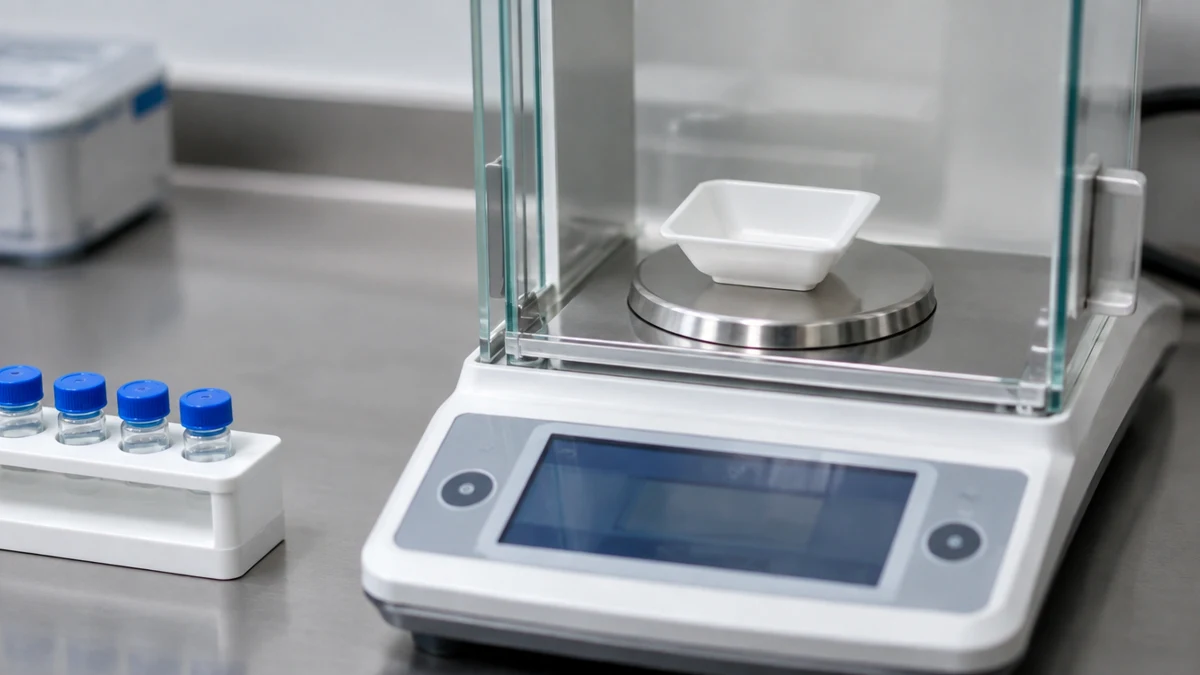
Featured image: AI-generated editorial illustration created through Higgsfield; not a photograph of Colossus facilities or testing.
Peptide content and chromatographic purity describe different measurements. Read the denominator before comparing percentages. A report can show a high fraction of a detected chromatographic signal while leaving the mass fraction of peptide in the submitted material as a separate analytical question.
Write the reporting basis beside the number
For purity, record the method and how the result was calculated. For content, record the reporting basis, units and quantitative method. A result may be expressed per mass of material, per container or on another specified basis. Never silently change that basis when moving a result into a spreadsheet.
| Example label | Question left open |
|---|---|
| 99% chromatographic area | What mass fraction or amount of target peptide was measured? |
| 80% content by mass | Which basis, method and sample does the assignment cover? |
| 5 mg nominal label amount | Is there a measured result for this filled unit? |
These are illustrative entries, not Colossus lot results. A label amount is not a substitute for a quantitative assay. Equally, a content result alone does not fully describe the identity or impurity profile.
Make calculations conditional on their inputs
Suppose a research calculation uses 10 mg of submitted material and a documented target mass fraction of 0.80 on the relevant basis. Multiplication gives 8 mg of target on that basis. This arithmetic is appropriate only if the reported factor actually applies to that sample and calculation. A chromatographic area percentage cannot be substituted automatically for the mass fraction.
The peptide content definition is a useful place to check terminology. The concentration calculator performs arithmetic on the mass supplied by the user; it cannot establish that mass experimentally.
Resolve ambiguous reports at the source
If a laboratory report uses “purity” and “content” without defining them, request clarification. Keep the explanation with the report so later users do not repeat the same assumption. A clear record preserves the original result, its units and its limits rather than replacing ambiguity with an unsupported precision claim.
Sources and scope
Source review: October 28, 2026. Educational material for qualified laboratory research; not for human or veterinary use. Examples are illustrative calculations or records, not Colossus lot results. Product-specific instructions and original reports control.

Leave a Reply